


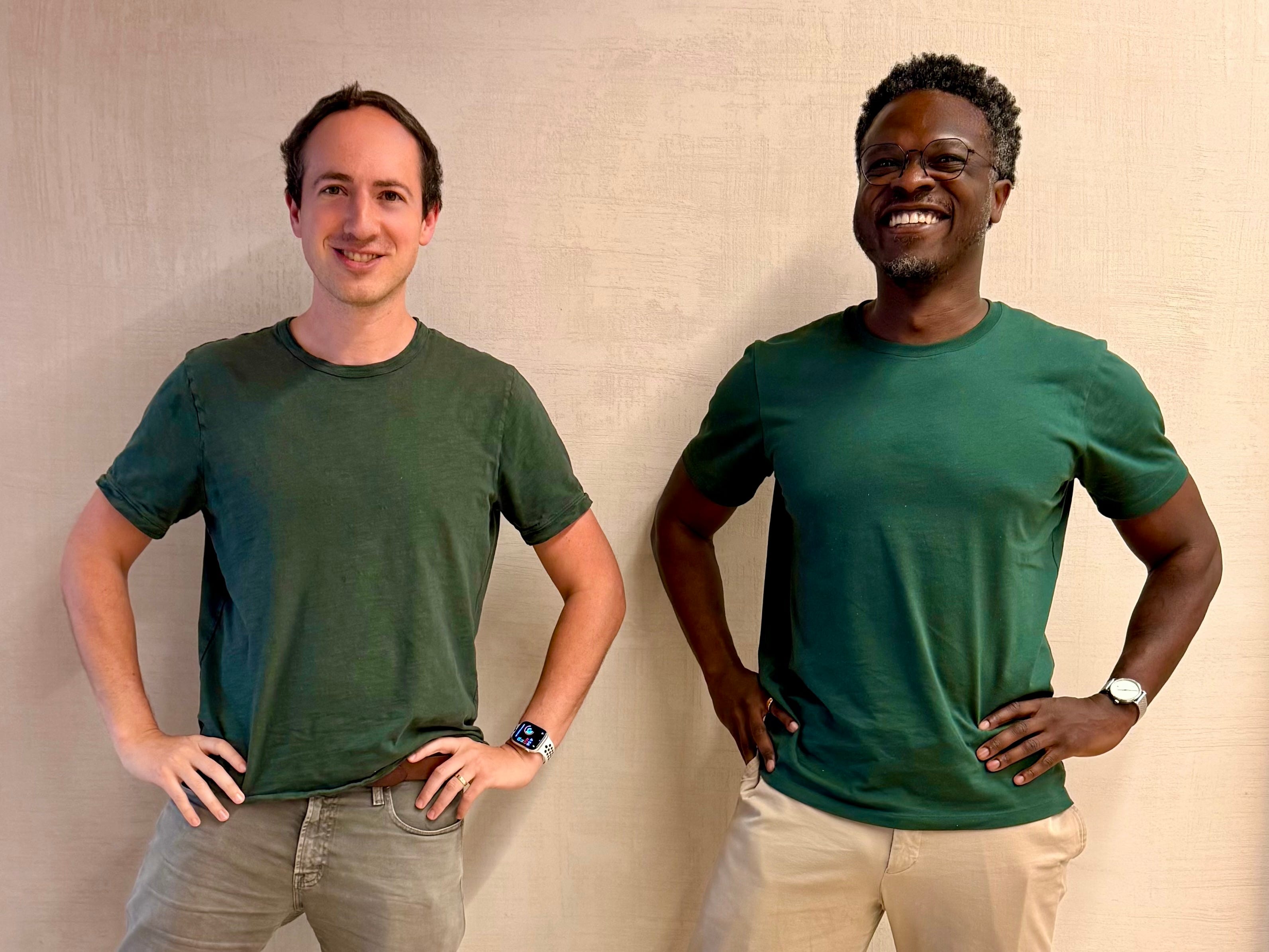
When they were leaders at Slack, Noah Desai Weiss and Dolapo Falola worked on software to help teams communicate better and faster.
Now, they’re building a startup to address a new problem for the AI moment: context.
A wave of AI assistants, coding agents and models theoretically empowers people to work more efficiently than ever before, argues Desai Weiss. But at a team level, it doesn’t always feel that way: “Everyone is racing, but what are they racing toward?”
So Desai Weiss and Falola teamed back up last year to build a new kind of product to tackle that disconnect. Today, they’re launching Scuba, a startup building a “context engine” for human workers and AI agents alike to know how a company likes to operate, and to better align on what they’re building toward.
“It’ll feel like the shared memory that your team has been missing,” says Desai Weiss, Scuba’s CEO. “The goal is to keep your team and all the agents that work for it continuously aligned, so people can move forward faster than ever.”
Given their pedigrees – the two met at Foursquare in the early 2010s, then worked together at Slack, where Desai Weiss was chief product officer, and Falola an engineering leader working closely with him before departing to lead engineering at The Browser Company – it’s no surprise that Scuba’s public launch comes with a lot of ecosystem support.
New York-based Scuba has already raised $34 million across two funding rounds, a pre-seed led by Accel and a seed co-led by Accel and IVP, its founders tell Upstarts exclusively.
Individual backers include Slack co-founders Stewart Butterfield and Cal Henderson, Stripe CEO Patrick Collison, Instagram co-founder and former Anthropic Labs co-leader Mike Krieger, LinkedIn co-founder Reid Hoffman and former CEO Jeff Weiner, Dropbox co-founder Drew Houston, Salesforce co-founder Parker Harris, as well as Upstarts Podcast CEO guests Christina Cacioppo of Vanta, Harvey’s Winston Weinberg, and Abridge’s Shiv Rao.
Hundreds of smaller teams have been playing with Scuba for the past six months, taking ‘Captures’ of artifacts they see around the web, from articles and videos to web pages and tweets, then organizing them in ‘Collections’ that can be shared with teammates and friends as an easily summarizable, searchable hub for info around a topic, or a guide to what the gatherers find interesting.
Users can then access that info elsewhere, like ChatGPT, Claude or Slack via Scuba’s MCP connectors; they can also save generated docs like evaluations or QA test runs directly back to Scuba, giving them a central home.
“Shared context is often a lot messier than you think,” Falola says. “It’s screenshots, PDFs, webpages, and ad hoc conversations. So Scuba gives you a way to have that shared memory available to you.”
🎧 The Upstarts Podcast 🎧 is back, and we kicked off Season 3 with a wild interview with a $10 billion-valued startup bringing back the woolly mammoth, Colossal 🦣. Check it out on YouTube, Apple, Spotify or wherever you get your podcasts.
At Upstarts, we’ve been tracking Scuba for more than a year, not long after each of our respective companies was founded, and well before Scuba had a name or product. In the summer of 2025, we got a tip that Butterfield, Slack’s former CEO, was involved in a new startup project. That turned out to be what was once known as Flashback, now Scuba, and I met Desai Weiss and asked to keep close tabs on what he built.
And Scuba’s product is interesting as one built for the current work software moment.
What Scuba is not: another AI assistant like Town, a document directory like Notion, a meetings tracker like Granola, a digital coworker like Cursor, an answers engine like ChatGPT, or a communication tool like Slack. Instead, Scuba represents an attempt to capture and amplify the collective taste, judgment and insights – the “hard-fought lessons learned,” Desai Weiss says – that its founders believe currently hold back AI tools from providing deeper value.
It’s too early to know if Scuba, at least in its current iteration, is the answer. But for knowledge workers adapting to the new normal of software options, it’s tackling what feels like a highly relatable problem.
“If we’d launched this a year ago, we’d have been too early,” Desai Weiss says. “It’s not that the models aren’t smart enough. It’s that it’s actually hard to give the models all the context you need, to get them to do the things you want.”
More on Scuba’s journey, investor perspective, and early impressions of its product below.
A MESSAGE FROM OUR SPONSOR
Ship pricing like a product

Different product bets have different business goals. You’re either chasing market adoption, revenue growth, or profits. You need to test fitting pricing models for each of those goals. Fast. Chargebee can help — Price for usage credits, outcomes, complex contracts, or any other modern commercial construct.
Special collections
Continuity is a theme at Scuba. Desai Weiss and Falola first worked together in 2011, when Desai Weiss led product at Foursquare and Falola was tech lead for some of its tools; at Slack, they worked together on collaboration products again starting in 2020. Four of the first hires at Scuba come from their shared Slack team.
To decide exactly what direction they took the product, Scuba’s founders made what Falola calls a “ridiculous” spreadsheet. The three top finalists each had eight rows of decision criteria, and received detailed grades.
Flashback checked off the most boxes as the tool they selfishly wanted themselves, that could help product engineering teams large and small like at their past shops, and that seemed like it would stand to benefit from – not compete with – with a fragmented, fast-moving AI-enabled work suite.
As a product, Scuba was designed to make recording Captures as easy as possible, via a small browser extension or iOS app; a lot more work went into Collections, which organize and store those Captures, and make them interactive across teams.
Within Scuba, its founders maintain two Collections that only they can edit: one stores everything around company strategy and product direction; another collects info on how staff are expected to talk about Scuba externally.
Scuba also works for sharing ideas across organizations. In recent weeks, Desai Weiss included Upstarts in one Collection he maintains of news, papers, and posts about “AI frontier implications” that he’s shared with 20 other founders and tech execs. Recent Captures include one of press coverage of an academically published paper about AI research, and one in which Clay (where Upstarts advisor Natalie works) shared its AI writing policy.
“I really loved these. Heavy ++,” Desai Weiss commented up top. “In this era, generating a 10-page vibed doc/plan/deck if you’ve barely read it so that N teammates spend the thinking time is woefully ineffective.” Scuba itself, meanwhile, recommended four key takeaways tailored for me, a longer AI-generated summary, as well as related links. (I could have added my own thoughts for all to see, or reacted with an emoji, Slack-style.)
I made one Collection myself, for tracking news and social media posts about the chaotic AI assistant race, but the product seems to really shine around launches. In a meta move, Desai Weiss included Upstarts on its “External Press Packet” for its public launch that includes this exclusive profile; there I could access the company’s own marketing materials and talking points to see how they compared with my own impressions.
I could also see what recent coverage the Scuba team thought was relevant, including a New York Times article on AI’s human “verification tax” and a post by Platformer’s Casey Newton about his experience building his own LLM wiki to keep track of past work. “He should become our top Scuba user,” Desai Weiss commented when he captured the piece over the weekend.
One of Scuba’s earliest and most prolific power users is Matt Wahl, another former product leader at Slack who now invests in and advises startups. A self-described “voracious consumer of the internet,” Wahl tells me when we chat in late September that he’s made no fewer than 336 Captures over the previous month, ranging from articles to call transcripts and Granola notes.
Some of those go to ‘Thought Fodder,’ a Collection he shares with ten or so founders that effectively replaced a text group chat. Often, they go to Claude, which Wahl tasks with combining a mix of voice notes and past screenshots and notes to organize his thoughts into investor memos to send to his portfolio.
“It meets the moment of what’s happening in AI right now,” says Wahl, who follows up the night before launch to tell me that he’s doubled down in Scuba’s new round, too. “All these tiny little decisions make it super fast.”
Putting a price on taste
Those product choices remind Andrew Braccia, the Accel partner who led the firm’s investments in both Slack and Scuba, of Butterfield and where Desai Weiss and Falola used to work. “It’s the details and the artistry of what’s being built, and how it’s being communicated,” he says, though he’s quick to note that Scuba is a new opportunity for “a new world.”
Braccia uses Scuba to collaborate with thought partners outside of Accel in healthcare projects that matter to him, heavily using its summaries to replace passing around PDFs or copy-pasted blurbs from ChatGPT. Within businesses, he sees Scuba creating daily value as a two-way knowledge base for teams working with AI coding tools (think the ones from Anthropic, OpenAI, Cognition, Cursor, Factory and others).
“You’re trying to build for your company based on your values, your ideas, your context. And you’re nervous about what you’re trying to do from a brand perspective,” Braccia says. “Understanding your company really well, you’re going to generate better code.”
Scuba’s own founders and backers concede the startup still has a lot to figure out.
What’s the right level of friction between intentional, manual capturing and automatically ingesting everything a worker is seeing or consuming? Scuba currently allows you to set some things to auto-collect, such as YouTube videos you watch, but its founders are cautious about over-sharing and maintaining privacy across individuals on a team.
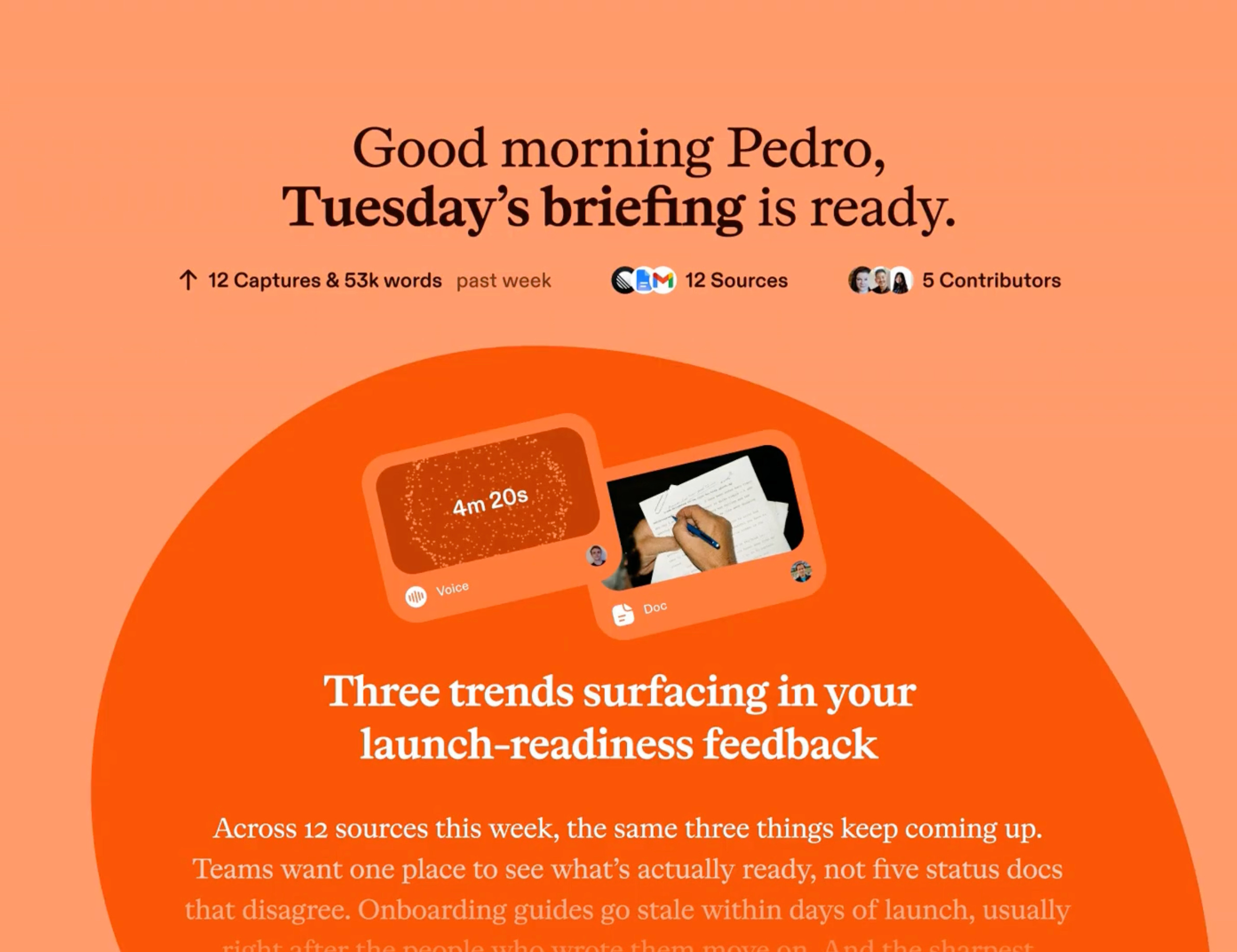
How much will people pay for Scuba? The app, available on Mac, iPhone and Windows, as well as the browser extensions, is still in limited access with a waitlist. Desai Weiss says the additional funding round, an opportunistic one co-led by Braccia and IVP general partner Shravan Narayen, is less about hiring costs or burn rate – Scuba’s still a small team of 10 with “many years of runway” – and more about being able to continue to “aggressively” let early users play with its full feature set before Scuba determines what pricing gates make the most sense.
“I would love to be able to play where we can give as rich of an experience to as many people as possible before we have to cover the costs and actually charge people,” Scuba’s CEO says. The AI models underpinning Scuba aren’t cheap, he adds: “It’s an interesting world right now, where the cost of running a service is meaningful again.”
Will Scuba be able to prove that value, or in the cliché-speak of Silicon Valley, become painkiller, not a vitamin? The startup’s founders say that to find out, they encourage new users to invite a handful of close teammates into Scuba, pick any one complex project, product launch or customer relationship, and then throw all their “messiest” context at it, and bring it to whatever other tools they use.
Do that enough, and Scuba can learn your and your team’s “taste,” Desai Weiss hopes. “Then your whole team will feel the magic of not everyone moving faster on their own, but moving further together.”
Big Scuba fan
🤿 Never losing that link, doc or thought ever again!