

Bell-Ringer To Bug-Hunter: Zoom CEO Eric Yuan Pushes Startup Speed, 15 Years In
A wide-ranging reunion interview covers 'Zoom 2.0,' buying startups, product-led growth, digital twins, deep fakes, and his quest for a four-day work week.


For years, CEO Eric Yuan avoided work travel — partly from personal preference, partly to push the use of his own video conferencing software at Zoom.
But when he did venture to New York, he would visualize his personal dream: ringing the bell at Nasdaq, on the day of his startup’s IPO. “I always told myself, ‘I’ve got to work hard,’” he says.
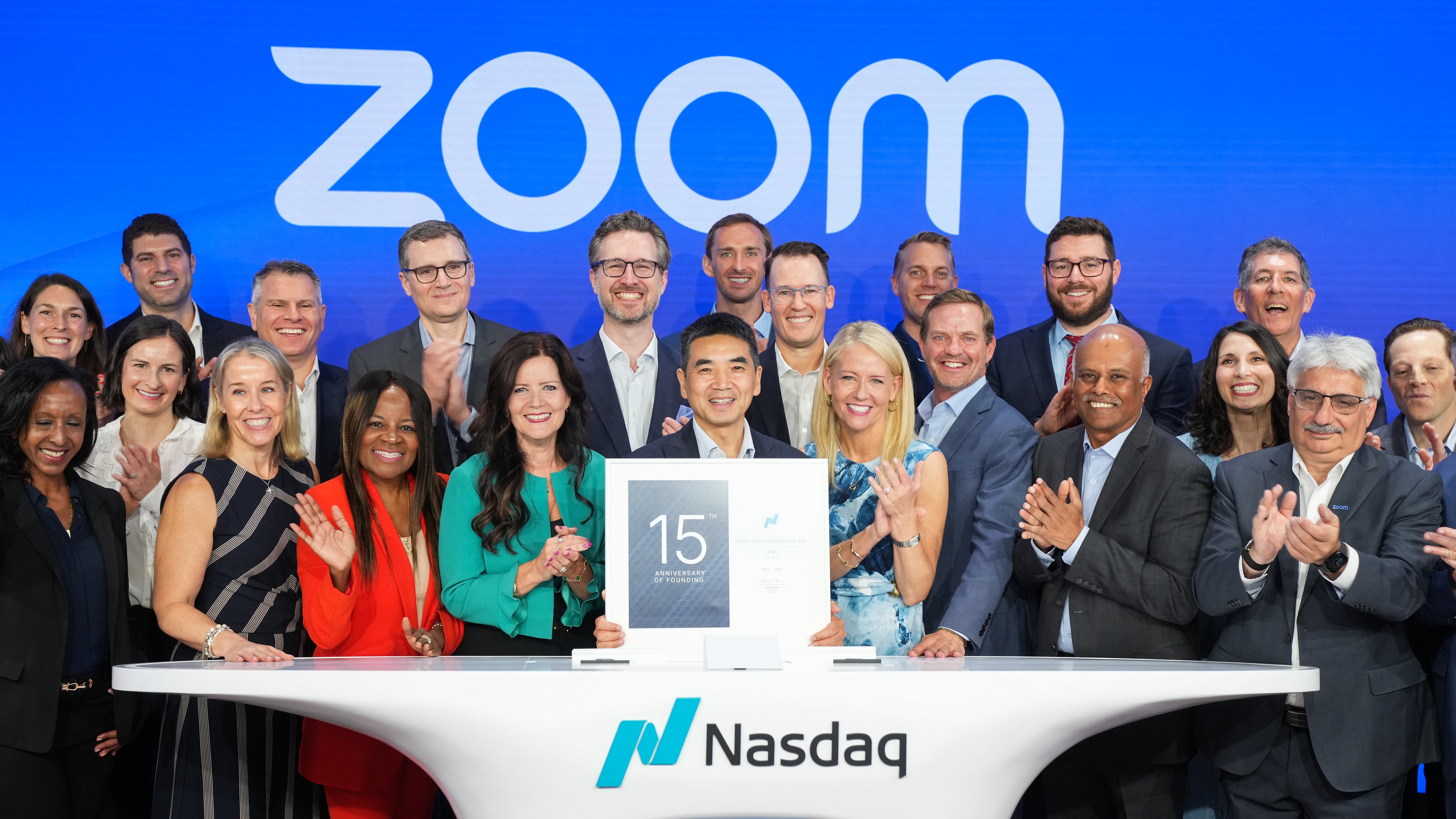
As we chat last week, Yuan is back in New York to celebrate Zoom’s fifteenth birthday. He’s loving the local energy. “Every time I’m in New York, I feel like we are in the middle of a new chapter. I feel my energy is up, and I want to do more things,” he says.
Our interview is a reunion. In April 2019, when Yuan’s dream finally came true and he rang the opening bell to take Zoom public, I was there, scribbling madly in a reporter’s notebook, for the first in-depth profile of Zoom, which ran in the next issue of Forbes.
When, as Covid-19 shut down in-person activities the next March, Yuan impulsively decided mid-Zoom interview with me that he would give away his software to every K-12 school in the U.S. (and in a bunch of other countries) for free, my resulting scoop went viral. It’s probably still the most-read story of my career. With Zoom on everyone’s mind, I followed that up with another profile, this time a Forbes cover story.
The pandemic is long over, and so are those heady days for Zoom’s stock. Its market cap sits under $30 billion, compared to nearly $140 billion at its peak.
But 15 years in, Yuan’s still running the show, meeting with customers and pinging engineers about bugs (more on that later). What motivates him, I wonder, when he’s achieved his dream — twice?
Now, Yuan focuses on work goals, he says: doing right by Zoom’s customers and employees, while pursuing positive impact in the world.
“My business goal is just to keep going,” he says.
He’s inspired by Jensen Huang, still calling the shots at Nvidia after 33 years, and Larry Ellison, still active in leadership at Oracle after nearly 50.
And he’s still fighting for you to use Zoom more, not less, in the AI era, even if that means personally annoying some of his engineers.
Why pay attention to what Zoom’s founder has to say? Our interview covered a lot of ground, with bits that should be relevant for startup founders, builders, and anyone curious about how one of tech’s most successful leaders sees AI impacting our society.
For startups, we cover Zoom’s current strategy; its approach to acquisitions; and Eric’s take on Anthropic and OpenAI.
For builders, we talk about why Zoom’s CEO still de-bugs code; its reinvestment in product-led growth; and how Eric thinks about AI meetings.
For society, we discuss the risk of deep fakes, where Zoom is working on a new product; how AI could spark more in-person interaction; and Eric’s bet on a four-day work week.
But let’s be clear: Yuan, despite a net worth estimated by Forbes north of $5 billion, doesn’t take himself too seriously.
“No matter what, the uptime, downtime, AI or not AI, just enjoy everything,” he says. “That’s the most important thing. This is in life, or startups.”
In the spirit of Yuan’s call to “enjoy,” we’re running this full interview for all subscribers, for free. If you enjoy it, we hope you’ll consider supporting Upstarts by purchasing an annual subscription: 20% off in our Summer Sale.
Zoom 2.0 (AI Edition)
The lightbulb moment for Zoom’s AI efforts wasn’t the rise of the transformer, or even the launch of ChatGPT. It came later, Yuan says now, when he and leadership realized how much faster some of the company’s engineers were shipping code using Cursor in early 2024.
“Looking back, I was not smart enough” to spot the trend sooner, Yuan adds.
Now, the focus is on what Zoom calls “completion”: a shift from orienting its products around the conversation itself (happening over video), to the business action or outcome discussed or agreed-upon in that virtual room.
It’s a “much bigger market opportunity,” Yuan argues, that means Zoom is investing more in capabilities to bring in more context before meetings, and to send updates to a CRM, or AI agent, after them.
Zoom has offered some of these tools for a while now, including a Granola competitor for note-taking called My Notes. (I agree to run both, in a bake-off of sorts. My verdict: Granola’s AI summary wins as more useful, and less corporate-coded; Zoom’s transcription is more accurate, although both struggle at times with the Chinese-American Yuan’s accent.)
Because Zoom comes from the starting point of a live conversation, however, Yuan believes that the company will only lightly overlap with partners like Salesforce, the owner of Slack, over time.
“Today, you cannot find any two companies where it’s very clean, there’s not any overlap,” he says.
Back to startup speed
Engineers who join Zoom expecting a slower, public company pace are often in for a bad time. When Zoom was a startup, much of its technical team had worked with Yuan for a long time, he says, and knew what to expect. Now, some complain that their CEO is pushing them hard. Directly, too: Zoom’s CEO says he engages directly with technical staff about issues, bypassing managers.
“It’s so slow, guys,” he admits he’ll say. “Competitors are shipping products. What are you doing?”
All these years later, Yuan still finds and reports bugs in Zoom’s products himself. “I’ll write a summary: ‘Guys, I only have 24 hours to myself. You have so many engineers, add up how much time you guys have. Why don’t you guys find those bugs? Why have only me find those issues?” It’s enough, he says, to drive him “crazy sometimes.”
Zoom’s recently-announced acquisition of Common Room isn’t about simply re-injecting some startup hustle into the organization, Yuan says. He pushes back on the notion that Zoom is looking to be more acquisitive now. “It’s hard to balance organic growth versus M&A,” he says. “We are still very disciplined.”
A near-miss acquisition validates that approach for Yuan. In 2021, Zoom announced its planned acquisition of Five9 for just under $15 billion. Five9 shareholders didn’t support the deal, and the two companies walked away that fall.
Instead, Zoom launched its own contact center solution recently; Five9 trades at a market cap of just about $2 billion. “Our progress is much better, and we didn’t spend so much money on that,” he says.
When I ask him why companies like Anthropic and OpenAI are seemingly buying up more AI startups, besides the disparity in equity value (with their private shares carried closer to valuations approaching $1 trillion), Yuan argues that the AI labs have more product needs across a wide surface area of infrastructure, hardware, models and agents, with more appetite for paying for talent.
Zoom, meanwhile, looks to university programs, up-skilling of veteran engineers, and to others who resonate with its mission in order to compete.
“No matter how much better you think a [pay] package is, somebody else will for sure offer a better one,” Yuan warns.
The gospel of PLG
The back-and-forth around me choosing to use Granola leads to a “pain point” for Yuan and Zoom: customers still think of it as “just a meeting company,” when it offers a much wider range of tools.
To change that, Yuan believes Zoom needs to get back to more of its product-led growth roots. My Notes grew to 1.5 million monthly active users in four months; that’s the type of adoption he wants to see more widely with ZoomMate, the AI companion the company offers in its productivity suite.
The challenge for Zoom: enterprise products and launches will still be driven by the sales team, and close engagement with big customers. Other launches need to inspire bottom-up new users. And, Yuan says, until recently, Zoom wasn’t systematically tagging each as one or the other.
“Now we try to have a formula for each product before we launch. We should say, ‘This one should start from product-led growth, or this one should start from a sales team approach,’” he says. “We should have a clear, defined go to market strategy.”
It’s the opposite challenge of many startups that lean heavily on PLG, then find out that it can only take you so far. They then scramble to build out enterprise tooling, customer success and forward-deployed capabilities to smooth over at-scale adoption.
Zoom, meanwhile, almost sounds like it’s fighting back against the Innovator’s Dilemma: “We thought inertia could help us,” Yuan says. “And that’s not right.”
For PLG products, Yuan believes cost and ease of use are most important. For sales-driven ones, trust and reliability.
“This is probably one of the things that keeps me up at night,” he adds. “We still need to address it.”
Digital twins, deep fakes, and the four-day work week
What Zoom is building towards above all – a selling point with those potential hires, Yuan says – is the concept of a ‘digital twin’ that Zoom can help power to work like us, and alongside us.
For the past three quarters, Yuan has used an AI avatar to read through the script of his earnings call, allowing him to join just for the live Q&A, the part he likes.
As another example, Yuan imagines an hour-long contract negotiation happening over Zoom. Most of that time – maybe 45 or 50 minutes – is spent running through the document and details, he posits; only the last 10 minutes or so is the actual live negotiating. Handing over the first part to our digital twins, we could spend more time conversing and building rapport or catching up, he argues, or moving on to other tasks.
What’s most interesting about Yuan’s position: he believes AI-enabled digital twins will improve and encourage more human face time, not take it away.
Talking to AI every day is lonely, he argues, and most people will want an emotional connection with other humans. Delegating work to a digital twin, he hopes, will free up more time for that.
Yuan is skeptical about AI simulation models replacing those negotiations – he thinks the tech isn’t ready yet to replace us altogether – and he doesn’t think human workers will embrace mixed meeting environments where half a Zoom is people, the other half avatars.
Zoom plans to announce a product soon around deep fake detection, he adds, that will be able to verify human identities in a meeting, or flag when videos are AI-generated and not labeled as such. “We need to make sure to tell participants,” he says. “Otherwise, if you don’t manage this well, it’ll be very dangerous.”

The tech leader’s boldest prediction, though, comes around the four-day work week. Yuan insists it’s coming. How soon? A few years to five, he replies, comparing the looming moment to 1926, when Henry Ford adopted an official five-day work week for his factories.
A big benefit of new technology is that it can handle more work for us, Yuan believes – freeing up more time for us to travel, work on philanthropic projects, or in our communities.
What’s the point in working hard if you can’t enjoy yourself, Yuan asks rhetorically. “‘Enjoy’ doesn’t mean this is a waste of time, a waste of resources,” he elaborates. “No, this is to do more meaningful things.”
I’m skeptical that Yuan’s peers in public companies will follow suit. Or if not them, their competitors in China. Getting Wall Street investors onboard seems like a challenge, too.
Yuan goes back to Ford, noting that in other countries, the five-day work week eventually caught on, too.
“It’s going to happen,” he insists. Will he lead by example, then? “I should lead by example, right?” he replies.
We’ll have to circle back in another five years, to check in on how Yuan is spending his Fridays.